BC.Game in Bhutan: identity, licence and risk checks

Assessment: amber. A reliable answer to whether BC.Game is a scam or legitimate in Bhutan requires separating three things that can easily be confused: the name shown to a user, the exact internet address being visited, and the legal entity that receives the customer relationship. The supplied identity packet names bc.game as the exact domain and Twocent Technology Limited as the operator. It also identifies an Anjouan licence, ALSI-202410011-FI1, with a listed expiry of 1 October 2026. None of that, by itself, establishes permission to offer gambling in Bhutan.
The decisive evidence gap is a current primary Bhutan record tying that precise domain and entity to local authorisation. No such match was supplied. The appropriate conclusion is therefore not “licensed in Bhutan,” “illegal,” or “proven scam.” It is an open-evidence finding: identity details are available, but local authorisation, payment performance and complaint outcomes remain unverified.
Brand, operator and hostname are different checks
A familiar logo cannot identify who legally owes a customer money. The domain identifies the internet destination; the operator name identifies the company said to provide the service; and a licence record should identify the entity and activities supervised by a regulator. A safe identity check requires those elements to agree rather than merely looking similar.
| Element | Supplied detail | What it establishes | What it does not establish |
|---|---|---|---|
| Brand | BC.Game | The name under review | Ownership, solvency or Bhutan approval |
| Hostname | bc.game | The exact domain named in the brief | That every lookalike address is connected |
| Operator | Twocent Technology Limited | The stated contracting entity | A current Bhutan licence |
| Foreign licence | Anjouan ALSI-202410011-FI1; listed expiry 2026-10-01 | A foreign licensing claim to verify with its issuer | Permission to operate in Bhutan |
Before creating an account, compare the address character by character. Extra words, altered punctuation, unusual subdomains and messages directing payment to a different destination are reasons to stop. A clone can reproduce colours and artwork while changing the entity, payment beneficiary or account credentials. The supplied logo is therefore a recognition aid, not a security seal.
What the foreign licence can and cannot answer
The packet identifies Anjouan licence ALSI-202410011-FI1 and records a listed expiry date of 1 October 2026. That detail should be treated as a foreign licensing statement, not as a Bhutan licence. A useful licence verification would confirm that the register is current, the named entity is identical to Twocent Technology Limited, the authorised activity covers the service offered, and the approved domain includes bc.game.
Even a successful foreign-register match would answer only part of the question. It might support an identity relationship and indicate that a foreign authority claims supervisory responsibility. It would not decide whether access, promotion, deposits or withdrawals are lawful for a person in Bhutan. Territorial permission must come from applicable Bhutan law or a competent Bhutan authority.
| Licence question | Status in supplied evidence | Practical consequence |
|---|---|---|
| Licence number supplied? | Yes | It creates a specific record to check |
| Listed expiry supplied? | 2026-10-01 | The date is not proof that the record remains active |
| Exact entity-to-domain match from a primary register? | Not supplied | Do not assume the relationship is verified |
| Bhutan authorisation? | Not supplied | Do not describe the service as Bhutan-licensed |
A licence number displayed in marketing material should never be the sole check. Registers can change, permissions can expire, and an authentic number can be copied onto an unrelated address. Verification should be repeated close to the time of use.
Is the service legal for users in Bhutan?
The evidence packet does not support a definitive legal conclusion for an individual user. It contains no current Bhutan licence or official decision naming the exact domain and operator. Foreign licensing cannot fill that gap. Anyone assessing legality should check the official Bhutan legislation portal for current statutes and amendments, then obtain qualified guidance where the rules or their application are uncertain.
Legal questions also vary by conduct. Accessing a website, creating an account, depositing, receiving a transfer, promoting a service and coordinating payments may be treated differently. The customer’s location, payment channel and purpose can matter. A site being technically reachable is not evidence of permission, and a payment completing is not official approval.
The practical safeguard is to pause before sending funds whenever local status cannot be established. The Bhutan legal guide explains the distinction between foreign licensing and local authority. No statement from customer support should be treated as a substitute for an official rule or decision.
Local enforcement context without guilt by association
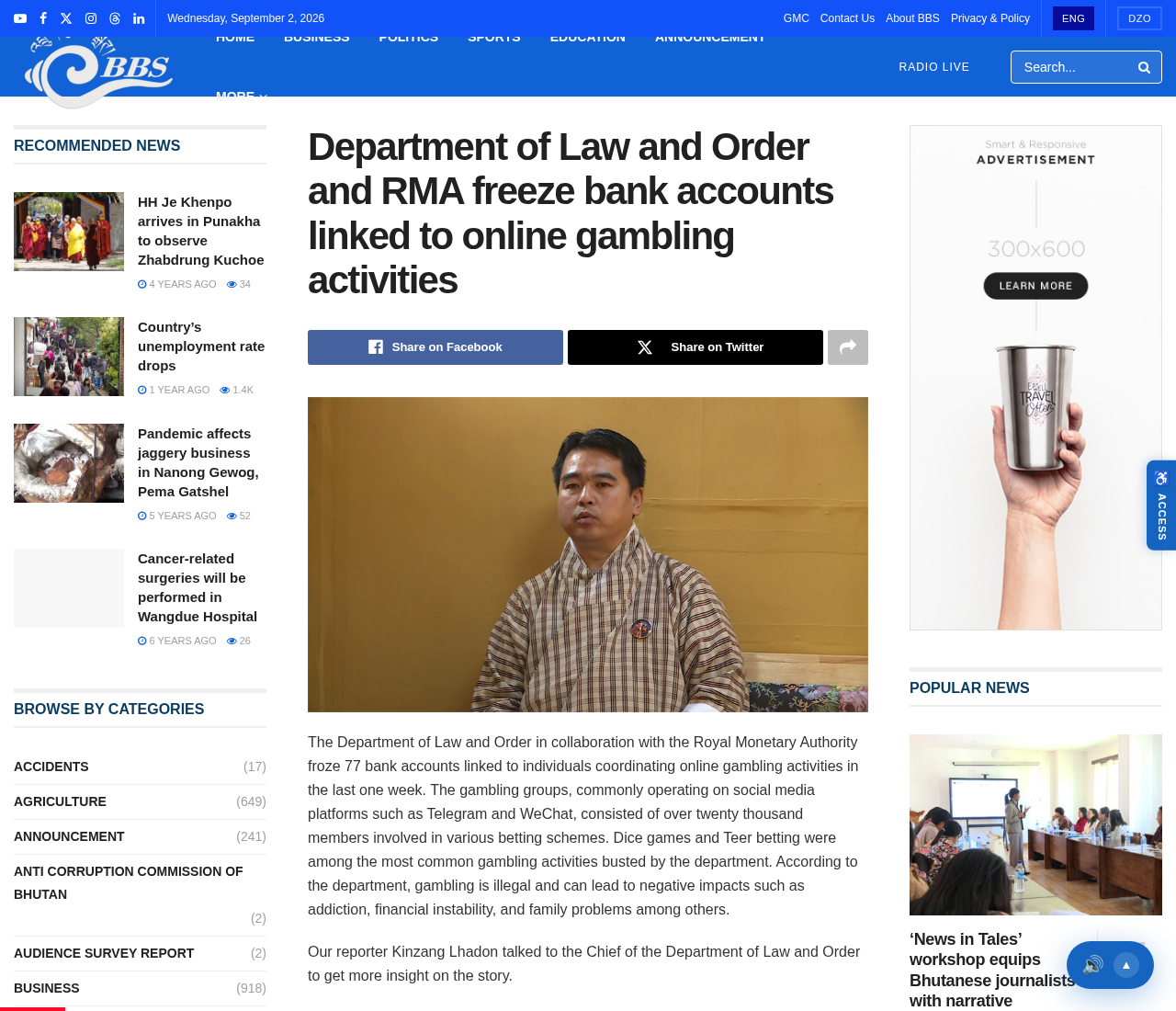
A BBS report on local enforcement says the DLO and RMA froze 77 bank accounts linked to online-gambling coordination. This is material risk context for Bhutan users because it shows that payment activity associated with online gambling can attract official attention. It is not proof against the selected operator, its domain or any particular customer.
The distinction matters. A general enforcement report cannot be converted into an allegation that a named company controlled the accounts, failed to pay customers or committed an offence. No supplied primary record makes those connections. The report should instead inform payment caution: users should understand who receives funds, preserve transaction records and avoid acting as an intermediary for other people.
Requests to receive, pool or forward gambling-related money create a different risk from paying only for one’s own account. A person should not let a third party use a bank account, wallet or identity document. Unexpected instructions to split transfers or use unrelated recipients warrant stopping the transaction and seeking guidance.
Deposits and the identity of the payment recipient
No verified list of deposit methods, currencies, limits or fees was supplied. It would therefore be unsafe to promise that a Bhutan-issued card, bank transfer, electronic wallet or digital asset will work. Availability shown during a session may depend on location, account status and third-party payment providers, and it may change without proving legal acceptance.
| Checkpoint | What to record | Warning sign |
|---|---|---|
| Account identity | Registered name and contact details | Someone asks to use another person’s identity |
| Payment beneficiary | Name displayed before confirmation | Unexplained individual or unrelated company |
| Amount and currency | Deposit amount, conversion and charges | Material difference from the confirmation screen |
| Transaction evidence | Receipt, reference number and timestamp | No durable confirmation is provided |
| Funding path | Source account and destination | Instruction to route funds through a third party |
A completed deposit proves only that a payment route accepted a transaction. It does not prove that withdrawals will use the same method, that the operator owns the receiving account, or that a dispute can be recovered through a Bhutan institution. Users considering any payment should review the broader payment-risk guide first.
Do not increase a deposit merely because a timer, bonus or message creates urgency. If the beneficiary changes between attempts, request a clear explanation before proceeding. Keep personal records outside the account so they remain available if access is lost.
Withdrawals, verification and unresolved performance
No withdrawal test exists in the supplied packet. There is no verified evidence about payout speed, approval rates, limits, fees, cancelled requests or the treatment of account balances. Consequently, neither smooth withdrawals nor systematic non-payment can be claimed.
Identity verification, often called KYC, may involve proof of identity, age, address, funding source or ownership of a payment method. The exact requirements for this service were not independently established. Before depositing, a prospective customer should determine what documents may be requested, how they are submitted, whether withdrawal verification differs from registration checks, and which entity controls the information.
| Withdrawal issue | Evidence status | Prudent response |
|---|---|---|
| Processing time | Unknown | Do not rely on an assumed same-day payout |
| Fees and limits | Unknown | Record the terms visible before depositing |
| KYC documents | Not independently verified | Confirm requirements before sharing sensitive files |
| Payment-method matching | Unknown | Check whether funds must return by the original route |
| Independent payout test | None supplied | Treat performance claims as unverified |
If a withdrawal is delayed, preserve the request time, status screens, transaction references and every response. Do not pay an unexpected “release fee” to an unrelated recipient without independently confirming its basis. A demand for repeated payments to unlock an existing balance is a serious warning sign.
Complaint recipient and escalation route
The first complaint should clearly identify the recipient. Account access, balance and withdrawal matters would ordinarily be raised with the entity presented as the operator, while a bank or payment provider may handle a transaction issue. The supplied evidence does not establish that any one Bhutan body will adjudicate a contractual gambling dispute.
BICMA publishes a content complaint redressal route. Its jurisdiction and the fit with the specific problem must be confirmed before filing. A content-reporting channel should not be described as a guaranteed route for recovering gambling funds.
- Write a short chronology with dates, amounts and account identifiers.
- State the requested remedy, such as an explanation, correction or transaction review.
- Attach only relevant records and redact unnecessary sensitive information.
- Keep the complaint reference and the exact response received.
- Use the complaint guide to identify the appropriate next recipient.
Threats, accusations unsupported by records and repeated submissions can weaken a complaint. Distinguish what can be documented from what is suspected. If fraud or unauthorised payment is suspected, contact the relevant financial institution promptly rather than waiting only for operator support.
Clone, impersonation and account-security checks
The exact hostname in the packet is bc.game. That does not authenticate links received through advertisements, messages, social-media profiles or unofficial applications. An impersonator may use a visually similar address, copied logo or fabricated support identity. Users should navigate from a previously verified address rather than following an unsolicited link.
| Check | Lower-risk observation | Stop condition |
|---|---|---|
| Address | Exact hostname expected | Misspelling, added word or altered ending |
| Credentials | Entered only on the verified service | Requested through chat, email or a form on another domain |
| Support contact | Reached from an authenticated account area | Unsolicited agent requests a password or one-time code |
| Payment instruction | Consistent beneficiary and documented amount | Personal account, secrecy request or rapid recipient change |
| Application file | Origin and publisher can be checked | Unknown download source or disabled security warning |
Use a unique password and enable available account protections. Never share a one-time code or remote access to a device. If credentials were entered on a suspected clone, change the password through a trusted route, secure the associated email account and review payment activity.
Evidence chronology, limits and verdict
All three primary sources in the ledger were checked on 2 September 2026. The legislation portal is the official place supplied for checking current statutes and amendments. The BBS record concerns the freezing of 77 bank accounts in a broader online-gambling context. The BICMA record supplies a content complaint route whose scope requires confirmation.
| Evidence ID | Role in assessment | Limit |
|---|---|---|
| BT-OFF-002 | Current-law checking route | No supplied record names the exact domain or operator |
| BT-LOCAL-002 | Bhutan enforcement and payment-risk context | Not proof against this service |
| BT-COMPLAINT-001 | Potential content-complaint route | Jurisdiction over gambling or payment disputes is unconfirmed |
The amber signal reflects open evidence, not a finding of wrongdoing. There is a stated identity map and foreign licence detail, but no current primary Bhutan record matching the precise domain, operator and local authority. Payments, withdrawals and verification outcomes have not been independently tested. Those gaps prevent a green assessment.
A red signal would require an official adverse record or corroborated documented evidence relevant to this entity and domain. None was supplied. A future green assessment would require current primary evidence supporting the exact identity and the precise claim being made; a foreign licence alone would still not prove Bhutan authorisation.
Decision checklist and correction path
Before making any commitment, confirm the exact address, operator identity, licence-register match, applicable Bhutan rules, payment beneficiary, withdrawal conditions and document requirements. Set a strict spending limit and never borrow, chase losses or treat gambling as income. Anyone experiencing loss of control should use responsible-gambling support; an immediate financial or personal crisis calls for urgent help.
Evidence can change. A correction request should identify the disputed statement, provide a dated primary record, explain the exact domain and entity relationship, and distinguish Bhutan authority from foreign licensing. Submissions can be made through contact. The review standard is described in the evidence methodology.
Continue after checking the exact domain
Frequently asked questions
Is BC.Game proven legitimate in Bhutan?
No. The supplied evidence contains no current primary Bhutan record matching the exact bc.game domain and Twocent Technology Limited. The amber assessment means the evidence remains open, not that wrongdoing has been established.
Does the Anjouan licence make the service legal in Bhutan?
No. The packet lists Anjouan licence ALSI-202410011-FI1 with an expiry shown as 1 October 2026, but a foreign licence does not establish Bhutan authorisation. Current Bhutan law and competent local guidance must be checked separately.
Are withdrawals proven to work?
No independent withdrawal test or verified payout record was supplied. Processing times, fees, limits, verification requirements and payment-method matching therefore remain unknown.
Does the report about 77 frozen bank accounts implicate this operator?
No. The BBS report provides local context about accounts linked to online-gambling coordination, but it is not proof against the selected domain, operator or any particular customer.
Can a complaint be sent to BICMA?
BICMA publishes a content complaint redressal route, but its scope should be confirmed before filing. The supplied evidence does not establish that BICMA will decide an account, withdrawal or contractual gambling dispute.
How can a clone be recognised?
Compare the hostname character by character, distrust unsolicited links, verify the payment beneficiary, and never disclose passwords or one-time codes to a supposed support agent. A copied logo does not prove that a website belongs to the stated operator.